
Carpentry in Acworth and Across Georgia
Quality carpentry designed and built for strength, functionality, and lasting craftsmanship. From decks, staircases, railings, fences, and screened-in patios to repairs and custom indoor and outdoor projects, we handle every stage of the build with attention to detail, delivering a clean, professional finish built to last.
What we build
Most carpentry calls start the same way. Somebody has a back yard they cannot use, a deck that has gone soft under the grill, or a patio that bakes from noon until dark. The fix is framing, and framing is what this crew does.
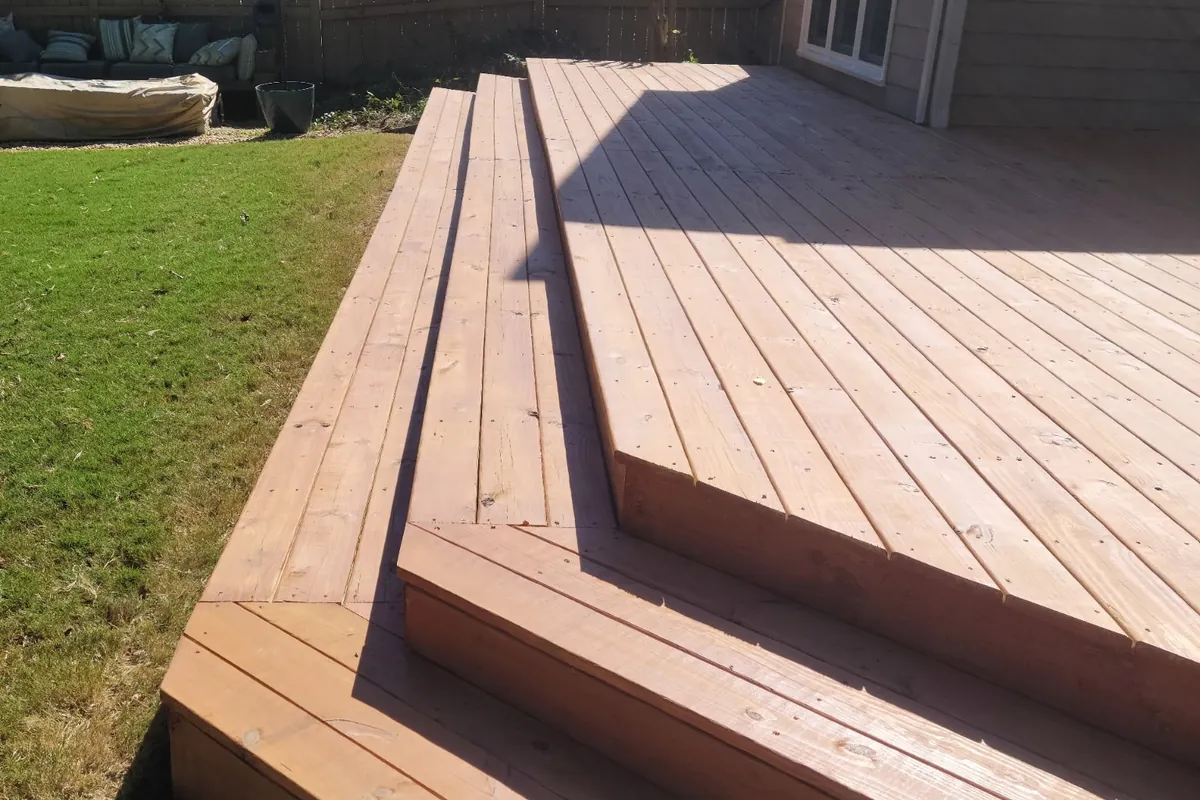
We build new decks, rebuild old ones, add stairs and landings, build and repair fences, put a pitched roof over a porch or patio, and screen in what is already there. Same company that cuts the grass and sets the pavers. One call, we do it all.
Pressure-treated or composite
This is the first question on every deck estimate and there is no single right answer. Georgia summers run hot and wet, and the two materials handle that differently.
Pressure-treated pine
Cheaper up front and easy to work with. It moves as it dries, so we let boards sit before we fasten the surface when the schedule allows it. Plan on cleaning and sealing it every couple of years. Skip that and the boards gray out, cup, and start splintering right where the afternoon sun hits.
Composite and PVC
Costs more at the lumber yard and less over the life of the deck. It does not rot, does not splinter, and does not need sealing. It does get warm underfoot in July, especially in a dark color on a yard with no shade, so we talk about color and sun exposure before you pick a board.
Either way the frame underneath is pressure-treated lumber. That is the part carrying the load and the part that rots first, so we tape the joists, flash the ledger, and keep post bases up off the red clay on standoff hardware.
Permits and inspections in Cobb County
Cobb County permits most decks. What triggers it is usually height above grade, whether the structure is attached to the house, and whether you are adding a roof. Cherokee, Bartow, Paulding and the cities inside those counties each run their own building department with their own submittal packet, so the answer changes with the address.
Here is what we will and will not tell you. We will tell you what the department asked for the last time we built something like this, we will pull the permit, and we will be there for the inspection. We will not promise you an approval, a fee or a review time, because none of those three belong to us. If you want the rule in writing before you commit, call the building department for your address and ask.
Rot, wobble, and the repair path
Decks in this part of the state fail in the same three places. The ledger where the deck meets the house, because water got behind it and took out the rim joist. The post bases, because somebody set a treated post straight into the ground. And the rail, because the posts were notched and lag-bolted instead of through-bolted.
When you call us about one soft board, we pull a board and look at the frame. Then you get a straight answer: this is a repair, or this is a rebuild and here is why. We have replaced ledgers and left good frames alone, and we have also given people the honest number on a deck that was not worth patching.
Screened-in patios and porches
A screen room turns a patio you use twice a year into a room you use from March to November. It also keeps pollen off the furniture, which anybody who has parked under a pine tree in April already understands.
We frame the walls and the roof, hang the screen, and set a door that closes on its own instead of banging. If there is already a slab or a deck we build on it, once we have checked that the footings under it will carry the load. If there is nothing there yet, we set the base first.
Roof pitches
A flat roof over a porch or an entry ponds water and fails early. Adding pitch gets the water moving toward a gutter and off the structure. That means new framing tied into the existing roof line, matched shingles, and flashing done so the tie-in does not become the new leak.
Shingle color is worth raising up front. A fresh bundle never matches a roof that has been in the Georgia sun for eight years. We match as close as the manufacturer still makes and show you the difference before anybody starts.
Carpentry We Take On
Decks, roof pitches, stairs and screened-in patios, plus the repair work that keeps an existing structure standing.
New decks
Single level, multi-level, wrapped or freestanding. Footings sized for the load, joists taped, ledger flashed into the house.
Fences
New fence builds and repairs. Privacy, picket and ranch rail, posts set to depth, gates hung so they still swing square a year later.
Deck rebuilds and repairs
Board replacement, rim joist and ledger repair, new rail systems, and full teardown and rebuild when the frame is finished.
Stairs, landings and rails
Even risers, solid stringers, and posts through-bolted to the frame so the handrail is still tight in five years.
Screened-in patios
Screen walls, a roof, and a door that latches. Built on an existing slab or deck when the footings will carry it, or on a new base when they will not.
Roof pitches and porch covers
Pitch added over a porch, patio or entry so water sheds to a gutter instead of ponding. Framed, tied in, flashed and shingled.
Post base and ledger corrections
The two spots where Georgia decks rot first. We get posts up out of the dirt and get the ledger flashed and fastened the way it should have been.
What Moves the Price
We will not put a number on this page that we cannot stand behind for your property. Here is what the estimate actually turns on.
Size, height and shape
A twelve by sixteen rectangle three steps off the ground is a different job than a wrapped multi-level deck eight feet up. Height drives the footings, the posts and the rail, and the rail is a bigger share of a deck budget than most people expect.
Material
Pressure-treated, composite or PVC, plus the rail system and the fastener you choose. Hidden fasteners cost more and leave a cleaner surface. We price the options side by side so you can see the difference.
What is already there
Tearing out and hauling off an old deck is real labor. So is working around a slab, a hot tub, a walkout basement door or a slope that will not take a wheelbarrow.
Permits and inspections
Where the work requires a permit, the fee and the inspection schedule belong to the county, not to us. We put them in the estimate up front so they are not a surprise in the middle of the job.
Three Steps, No Runaround
-
We walk it and measure
We look at the grade, the door height, the ledger wall and where the water goes. If there is an old structure, we pull a board and check the frame.
-
You get the scope and the number
Material, size, rail system, permit if the address needs one, and the price. In writing, before anybody buys lumber.
-
We build it and clean up
Footings, frame, surface, rail, stairs. Then the cutoffs and the packaging leave with us and the yard gets blown down.
Deck and Carpentry Questions We Get
Do I need a permit to build a deck?
Usually yes. Cobb County permits most decks, and the trigger is normally height above grade, attachment to the house, or adding a roof. Neighboring counties and city building departments each set their own rules, so the answer depends on the address. In Cobb that is Community Development. We pull the permit and we are there for the inspection, and we will not promise you an approval or a review time that the county controls.
Pressure-treated or composite?
Pressure-treated costs less up front and needs cleaning and sealing every couple of years. Composite costs more at the yard, does not rot or splinter, and runs warm underfoot in a dark color. The frame under both is pressure-treated lumber either way. Tell us how you plan to use the deck and we will tell you which one we would put on our own house.
Can you repair my deck instead of replacing it?
Often, yes. We pull a board and look at the frame, the ledger and the post bases before we quote anything. If the structure is sound you get a repair number. If the frame is gone you get the rebuild number and the reason, in writing, so you can make the call with real information.
How long does a deck take to build?
Once material is on site, most residential decks run from a few days to a couple of weeks of build time depending on size, height and whether there is a roof over it. Weather and inspection scheduling move that, so you get a window from us instead of a promise on a date we do not control.
Can you screen in a porch that is already built?
Yes, as long as the existing slab or deck and the footings under it will carry the walls and the roof. We check that before we quote it. If the base will not hold it, we tell you what it would take to make it work rather than screening a structure that should not be carrying the load.
Do you build outside Cobb County?
Yes. Kennesaw is home and most of our work is in Cobb, but we serve all of Georgia. Call with the address and we will tell you what the trip looks like before you spend any more time on it.
Free Estimates. Residential & Commercial.
Tell us what you want built and Hunter will get you a number. There is no charge to have us come look.
Licensed & Insured · 10+ Years of Trusted Service · Serving All of Georgia