
Irrigation and Sod Installation in Acworth and Across Georgia
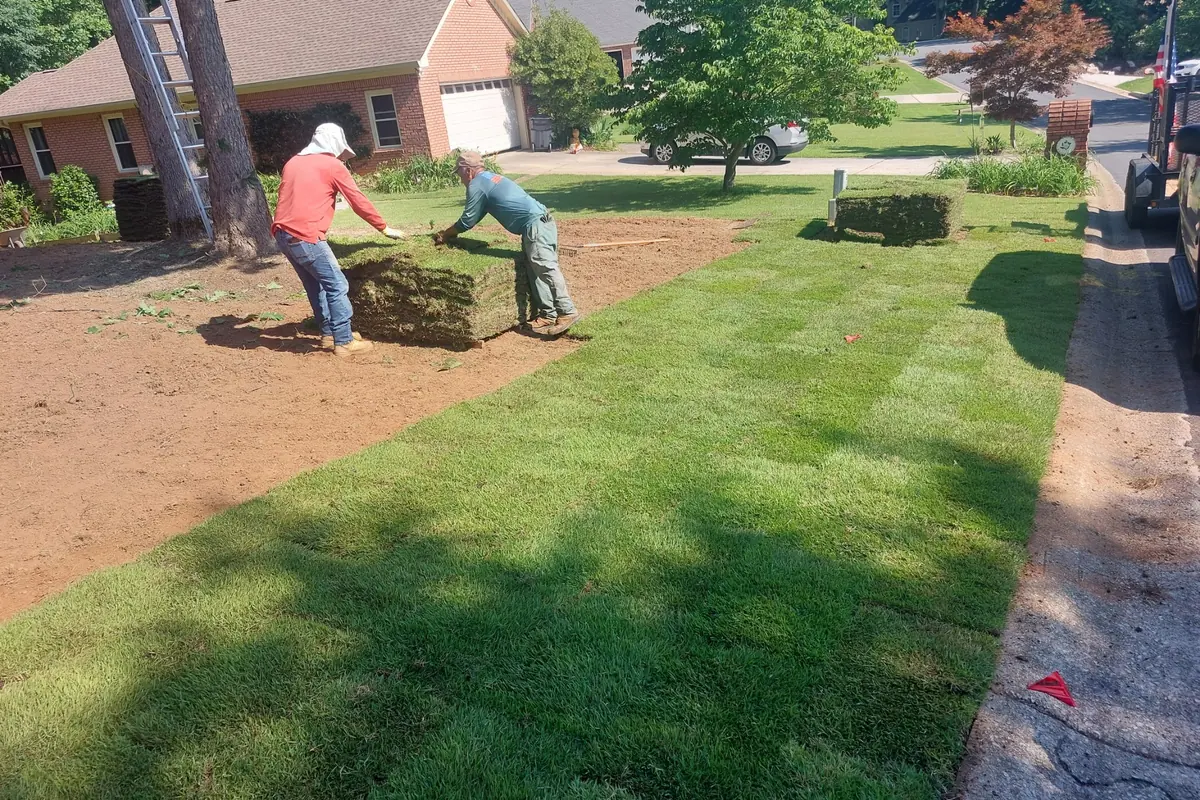
Irrigation system installation, repairs, and zone adjustments, along with professional sod installation. From proper grading and ground preparation to laying and rolling, we make sure your new lawn is installed right and ready to establish strong, healthy roots.
Sprinkler systems built around the water you actually have
Every irrigation design starts with two numbers: the static pressure at the spigot and the gallons per minute the meter will give you. Those two decide how many heads go on a zone. Put too many on and every head in that zone throws short, which is why so many yards have a dry ring ten feet out from the sprinkler.
After that it is a matter of matching the head to the ground. Rotors for open turf, spray heads for the tight strips along a drive or a walk, drip line in the beds where overhead water just feeds the weeds and rots the mulch.
What good zone design looks like
- Head to head coverage. The spray from one head reaches the next one. Sprinklers are built to overlap, not to each cover their own circle.
- Turf and beds on separate zones. Always. They do not want the same water and they do not want it for the same length of time.
- Sun and shade split. A fescue strip under a hardwood does not want the run time an open Bermuda lawn needs in July.
- Slopes on their own zone so you can run short cycles and let it soak instead of watching it run down the hill.
- Heads set back off the concrete. Water on the driveway is money on the driveway.
Backflow prevention
The state sets when you are allowed to run it. Georgia's Environmental Protection Division limits outdoor landscape watering to between 4 p.m. and 10 a.m., and newly installed sod or seed is exempt for the first 30 days. We program the controller around that so you are not guessing.
A sprinkler system tied into the house supply needs a backflow preventer. It is the device that keeps water sitting in a lateral line, down in the mulch with the fertilizer, from being pulled back into the drinking water when pressure drops. Georgia water providers require one, and most of them require a certified test on a set schedule.
We install it, we set it where it can be tested without digging it up, and we tell you what you own so the first test notice is not a surprise. Ask your water provider what they want for your address, because the interval is not the same everywhere in the metro.
Programming the controller for Georgia clay
Clay does not take water as fast as a sprinkler puts it down. Run a zone twenty minutes straight on a grade and most of that water ends up in the street. The fix is cycle and soak: run the same zone three times for seven minutes with a gap between, and the ground gets all of it.
- Water in the early morning. Between 4 and 9 the wind is down, evaporation is low, and the blades dry before dark.
- Use the seasonal adjust. A schedule that is right for July is roughly double what the lawn needs in April.
- Put a rain sensor on it. It pays for itself the first wet week in March.
- Georgia limits landscape watering by time of day, and newly installed sod and seed get an exemption window. Ask your water provider what applies to your address before you set the clock.
Repair or replace
Most systems are worth repairing. Heads, nozzles, a cut lateral, a stuck valve and a dead solenoid are all normal wear, and none of them are a reason to start over.
Repair it
- Heads that are broken, sunk, tilted or throwing the wrong pattern
- A wet spot that never dries, which is usually a cracked lateral or a bad seal
- A zone that will not come on, which is usually the solenoid or the wire and not the valve body
- A controller that lost its program, or one nobody ever showed you how to use
Worth replacing
- A layout built for a yard that no longer exists, where the beds moved and half the heads water the fence
- Zones carrying more heads than the water supply can feed, which is a design problem no repair fixes
- Poly line that has been patched a dozen times and splits somewhere new every spring
- No backflow preventer at all, or one nobody can locate
Sod that survives a Georgia summer
The right grass comes down to sun, traffic and how much you are willing to water. Here is the honest version.
Bermuda
The default for an open, sunny Georgia lawn. It takes heat, drought and foot traffic better than anything else we install and it repairs itself. It wants at least six hours of direct sun, and it goes fully dormant and tan from the first hard frost until April. If a green winter lawn matters to you, Bermuda is not your grass.
Zoysia
Denser and finer than Bermuda and it will take a few hours of shade. It chokes weeds out better than anything else on this list. It also goes dormant in winter, it costs more, and it is slower to knit in, so it wants an owner who will water it right through the first summer.
Tall fescue
The cool season option and the only one here that stays green through a North Georgia winter. It handles shade under hardwoods, which is why so much of Cobb County is in fescue. The trade is August. Fescue in open sun needs real water in July and August or it thins, and it usually wants overseeding every fall.
Centipede
Low input and happy in acidic clay. It does not want much fertilizer and it does not want traffic. Good for a low-maintenance sunny yard, slow to recover once something tears it up.
Sod or seed, honestly
Sod costs more and gives you a lawn the day it goes down. Seed costs less and gives you a lawn if the weather cooperates and you water it for a month.
- Timing. Fescue seed goes down in September and that is the only reliable window. Bermuda seed goes in late spring. Sod can go down almost any month you can keep it wet.
- Erosion. On any real grade, seed washes. Sod holds the day it is laid.
- Weeds. Bare soil grows whatever blows in. Sod arrives as a finished stand of grass with no gaps to fill.
- Cost. Seed is a fraction of sod per square foot. Add the water and a month of your attention and the gap narrows.
- The short answer. Seed a big open backyard in September. Sod the front, sod anything on a grade, and sod anything that has to look finished this month.
Watering a new lawn
Sod dies at the seam from drying out, not in the middle of the piece. The first two weeks decide whether you bought a lawn or a bill.
- Days 1 to 14. Keep the soil under the sod wet, not just the blades. In summer that is usually twice a day, morning and early afternoon, long enough to soak through into the dirt below.
- Days 15 to 21. Once a day, longer run, in the morning.
- Weeks 4 to 6. Every other day, longer still, so the roots chase the water down instead of sitting at the surface.
- After that. About an inch a week including rain, split into two or three soakings, early morning.
Two tests worth doing. Set an empty tuna can on the lawn while a zone runs and time how long it takes to fill an inch. That is your run time. At two weeks, take a corner of a sod piece and pull up. If it resists, it has rooted.
How an Install Goes
The order matters. Skip the first step and the whole system throws short.
-
We check pressure and flow
Static pressure at the spigot and gallons per minute at the meter. Those two numbers set the zone count before anything gets trenched.
-
We lay it out and pull pipe
Heads staked to the design, pipe pulled, valves set in boxes you can actually reach, and the backflow set where a tester can get to it.
-
We tune it and hand you the clock
Every head adjusted so the water lands on grass. Then we program the controller, walk you through it, and write down what each zone covers.
How We Handle Irrigation and Sod
Two trades that fail for the same reason: somebody skipped the measuring.
Designed to your numbers
Pressure and flow get measured before a zone is drawn. That one step is the difference between a system that covers the yard and one that browns a ring around every head.
Repair before replace
If the system can be fixed, we fix it. Replacement gets recommended when the layout itself is wrong, and we will show you why rather than just quote it.
You get the schedule in writing
Zone map, run times and the watering plan for the first six weeks. New sod fails from the wrong schedule more often than from bad sod.
Irrigation and Sod Questions
How long before I can walk on new sod?
Stay off it for the first two weeks except to move a sprinkler. At two weeks, take a corner and pull up. If it resists, it has rooted and normal foot traffic is fine. Give it a month before a dog or a football gets on it.
Bermuda, zoysia or fescue for a Georgia yard?
Bermuda for open sun, heat and traffic, if you can live with a tan lawn from November to April. Zoysia for a denser lawn that takes a little shade and costs more to put in. Tall fescue if you have hardwood shade or you want green all winter, knowing it needs water in August and overseeding most falls.
Should I sod or seed?
Seed a big open backyard in September and save the money. Sod the front, sod anything on a grade where seed would wash, and sod anything that has to look finished this month. Sod also skips the month of weeds that comes with bare soil.
Do I need a backflow preventer on my sprinkler system?
Yes. Any irrigation system tied to the house water supply needs one, and Georgia water providers require it. Most also require a certified test on a schedule. Ask your provider what they want for your address, because the interval is not the same everywhere.
My system runs but half the yard is brown. Repair or replace?
Almost always repair. A dry ring around a head is a nozzle or a pressure problem. A zone that will not come on is usually a solenoid or a wire. Replacement is the answer when the layout itself is wrong, when a zone carries more heads than the water will feed, or when the poly line splits somewhere new every spring.
How much should I water new sod?
Twice a day for the first two weeks, enough to keep the soil under the sod wet and not just the blades. Then once a day for a week, then every other day, then about an inch a week including rain. Water in the early morning once it is rooted.
Can you work on a system somebody else installed?
Yes. Most of the irrigation work we do is on systems we did not put in. We find the valve boxes, map the zones, fix what is broken and tell you what is fine to leave alone.
What Goes With a New Lawn
Residential Lawn Maintenance
Weekly and bi-weekly mowing, edging, weed eating and blow-off, cut at the right height for the season.
Learn moreDrainage Solutions
French drains, catch basins, downspout extensions and regrading. Georgia clay does not drain on its own.
Learn moreLandscape Design
Beds, borders, trees and seasonal color planned around North Georgia clay, shade and slope.
Learn moreFree Estimates. Residential & Commercial.
Tell us about your property and the work you’re looking to have done. Owner and operator Hunter Henderson will personally come out to meet with you, walk the property, discuss your project, and provide a free, no-obligation estimate—never a third-party estimator.
Licensed & Insured · 10+ Years of Trusted Service · Serving All of Georgia