
Fire Pits in Acworth and Across Georgia
Custom fire pits, outdoor fireplaces, and seating areas built with stone, pavers, and block to fit your property and vision. Designed for both function and appearance, we create outdoor spaces perfect for relaxing, entertaining, and enjoying your backyard year-round.
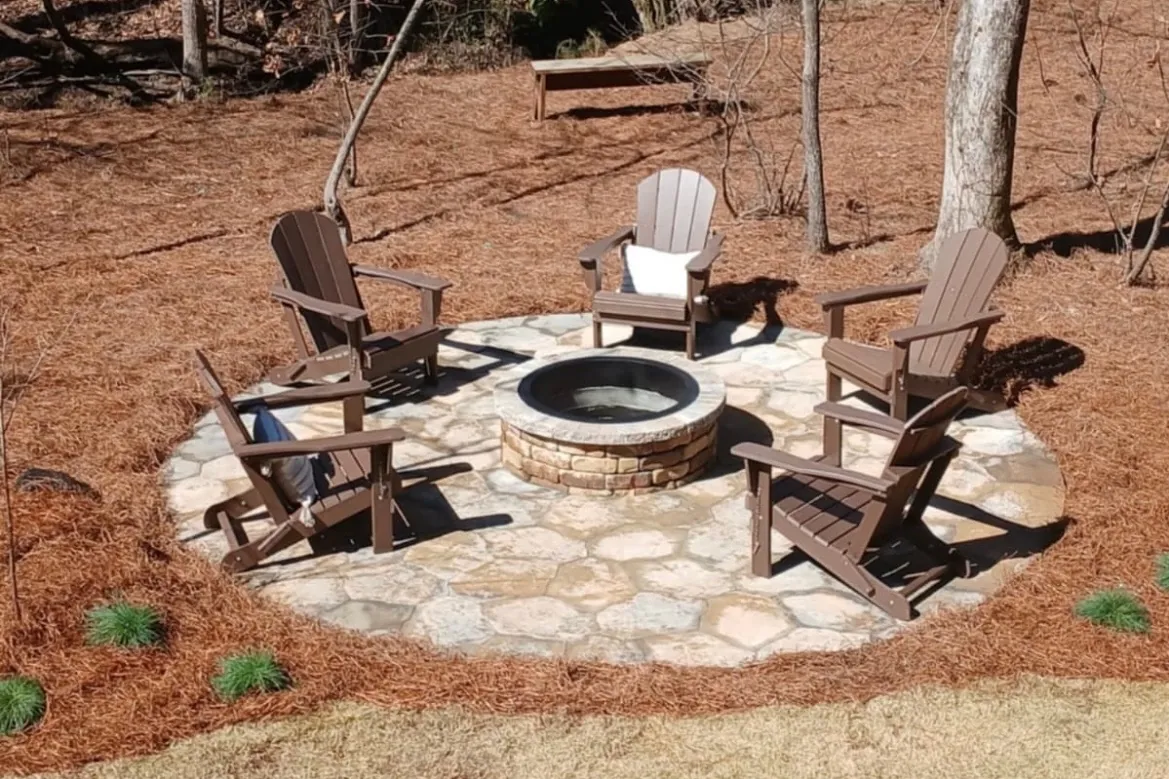
Built-in or freestanding
This is the first fork in the conversation and it decides most of the rest.
Built-in
A permanent ring of wall block or natural stone set on a compacted base, capped, and tied into the patio around it. It does not move, it does not rust out, and it reads as part of the house instead of something you bought at a big box store. If you want a seat wall around it, this is the version that gets one.
Freestanding
A steel bowl or a kit on a pad. It costs less, it goes in the same day, and you can move it if you change your mind about where the yard should be pointed. What you give up is the finish and the seat wall. We will set a proper pad under one so it does not sink into the clay and start leaning by August.
Gas or wood
Wood burning
Cheaper to build because there is no gas line, no burner and no permit conversation about one. Real fire, real heat, and the smell people are actually after. The trade is that smoke follows you around the circle no matter where you sit, somebody has to haul and store the wood, and there is ash to clean out.
One thing to check before you build: open burning rules are set by your city, your county and sometimes your HOA, and they are not the same across the metro. We are not going to quote you a rule that may not apply to your address. Find out what yours says and we will build to it.
Gas
On and off with a switch. No smoke, no ash, no hauling wood, and it works on a Tuesday night when you have twenty minutes. It costs more, and it needs either a natural gas line run to the spot or a hidden propane tank with an access door built into the structure.
Here is the honest scope line. We build the structure, set the burner pan, the ring and the sleeve, and leave the connection point where it needs to be. A licensed gas professional runs and connects the line. That is not us being cautious for the website; that is the right way to do it.
Materials
Wall block and pavers
The workhorse. Manufactured wall block comes in colors that match common paver patios, it stacks fast, and the cap gives you a clean edge to set a drink on. If you already have a paver patio, we can usually get close enough on color that the pit looks original to it.
Natural stone
Fieldstone and Tennessee flagstone look better than block and cost more, because somebody has to fit each piece by hand. On a property with stone on the house or a stone wall already in the yard, it is worth the extra mason time. On a plain back yard, block with a good cap gets you most of the way there.
Fire brick and steel
This is the part nobody sees and the part that decides whether the pit lasts. The inside face has to be fire brick or a steel insert ring. Regular pavers and standard concrete block hold moisture, and heat drives that moisture out fast enough to spall the face off. A pit built without a liner starts shedding chunks inside a season or two, and there is no good way to fix it after the fact.
Seat walls and the space around it
The pit is the easy part. The circle around it is what makes the space work.
Plan on around six to seven feet of clear surface from the outside face of the pit to the edge of the patio. That is enough for a chair, somebody's legs, and room to walk behind them without turning sideways. Anything tighter and the whole group ends up sitting with their knees on the stone.
A seat wall runs about eighteen inches to the top of the cap, which is chair height. Built along one arc of the circle it adds real seating without adding furniture that has to be stored every winter. On a sloped yard the same wall does double duty as a low retaining wall, which is often the reason the patio was possible at all.
How it ties into a patio
The best time to build a fire pit is the day the patio goes in. One base, one compaction, one crew, one mobilization, and the pavers get cut around the pit instead of being lifted later. It is the cheapest version of this project by a wide margin.
If the patio is already down, we can still cut a pit into it. That means lifting pavers, adding base where the pit will carry weight, building the structure, and re-cutting the field around it. It works and it looks right, it just costs more than doing both at once.
Placement is worth ten minutes of conversation. Out from under the roof overhang and the low tree limbs. Downwind of the door if the prevailing wind has an opinion. Off the septic field and away from the drain line we may have just buried. And far enough from the house that nobody is nervous when the fire is actually going.
What We Build
Fire features that match the patio and the house, built on a base that holds in Georgia clay.
Built-in paver fire pits
Wall block and cap in a color matched to your patio, set on compacted base with a fire brick or steel liner inside.
Natural stone fire pits
Fieldstone and flagstone fit by hand. The right call when there is stone on the house or already in the yard.
Outdoor fireplaces
A vertical fireplace with a chimney where you want the smoke going up instead of across the seating, and a mantle to sit things on.
Gas burner pits
Structure, burner pan, ring and sleeve built and set. A licensed gas professional makes the final connection.
Seat walls and benches
Eighteen inches to the cap, curved to the circle, doubling as a low retaining wall where the yard falls off.
Patio and fire pit packages
Both in one trip. One base, one compaction, one crew, pavers cut around the pit instead of lifted later.
What Moves the Price
A fire pit can be a weekend or a project, and the gap between them is real. Here is what decides which one yours is.
Wood or gas
Gas adds a burner assembly, a sleeve, an access door if there is a tank, and a licensed trade for the connection. Wood needs none of that. This is the single biggest swing in the estimate.
Material and size
Manufactured block goes up fast. Natural stone is hand-fit and takes a mason longer. Diameter matters less than you would think; the seat wall and the patio around it are the bigger numbers.
New patio or existing
Built with a new patio, the pit rides along on work that is already happening. Cut into an existing patio, it means lifting pavers, adding base and re-cutting the field around it.
Grade and access
A flat back yard with gate access is straightforward. A slope needs a wall and drainage behind it before anything gets set, and a yard reachable only by wheelbarrow adds labor to every ton of material.
Three Steps, No Runaround
-
We stand in the yard with you
We mark the circle with paint, check the overhang, the trees, the wind and the utilities, and talk about how many people you actually want sitting around it.
-
You pick the material and get the number
Block or stone, wood or gas, seat wall or no seat wall. You see the options priced side by side before anything is ordered.
-
We excavate, compact, build and clean up
Base first, then the structure and the liner, then the cap and the surface around it. The pallets and the spoil leave with us.
Fire Pit Questions We Get
Built-in or freestanding?
Built in, if the spot is settled and you want a seat wall. It costs more, it does not move, and it looks like it came with the house. Freestanding makes sense when you are renting, when the yard is going to change in a couple of years, or when the budget says this year is the pit and next year is the patio. Either way we set a proper compacted base so it does not sink into the clay.
Gas or wood?
Wood costs less to build and gives you the fire and the smell people want, at the price of smoke, hauling wood and cleaning ash. Gas costs more and gives you a fire in ten seconds with nothing to clean up, which in practice means you use it far more often. If you entertain on weeknights, gas usually wins. If the fire is the event, wood usually wins.
Can you put a fire pit on my existing patio?
Yes. We lift the pavers where the pit goes, build up base that will carry the weight, set the structure and the liner, then re-cut the field so the joint looks intentional instead of patched. Matching an older paver exactly is not always possible after a few years of sun, so we will show you the closest match we can get before we start.
How much room do I need around it?
Plan on about six to seven feet of clear surface from the outside face of the pit out to the edge of the patio. That gives you a chair, somebody's legs, and room to walk behind them. Tighter than that and everybody ends up with their knees against the stone, which is the most common complaint we hear about a pit somebody else built.
Do I need a permit, and what about burn rules?
Open burning rules are set by your city, your county and sometimes the state, and HOA covenants add their own on top. They are not the same across the metro and they change with the season. We are not going to quote you a rule that may not apply to your address. Check with your fire marshal or your HOA, tell us what it says, and we will build to it.
What keeps a fire pit from falling apart?
A liner and a base. The inside face has to be fire brick or a steel ring, because heat drives moisture out of ordinary block and pavers fast enough to pop the face off. Under it, compacted base and proper drainage keep the ring from settling unevenly and opening the joints. Both are hidden when the job is done, and both are the difference between a pit that lasts and one that starts shedding after two seasons.
Free Estimates. Residential & Commercial.
Tell us where you want the fire and Hunter will get you a number. There is no charge to have us come look.
Licensed & Insured · 10+ Years of Trusted Service · Serving All of Georgia